Alloa · Clackmannanshire
A sandstone house, held above the parkland.
Greenfield House rose in the 1890s for a dynasty of Alloa spinners — elegant, art-hung, crowned by a four-storey tower. It has since survived fire, the long municipal years, and a spell of neglect. This is its story.
Built 1892–94 Grade B listed Mar Place, Alloa
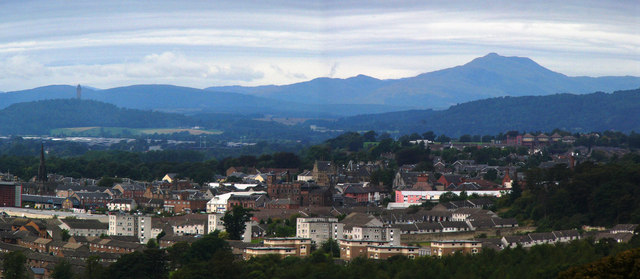

More than thirteen decades after the first stone was laid, Greenfield House still holds its ground north of the town — scorched once, sold twice, and lately brought back into public hands.
A single house, and the greater part of Alloa's modern story.
I · Origins
A house for the house of Paton
Greenfield House was raised between 1892 and 1894 to the designs of the Edinburgh architects A. G. Sidney Mitchell & Wilson.
It was built for David Paton Thomson — a director of John Paton, Son & Co. Ltd, the great Alloa spinning firm, and a former Deputy Lieutenant of Clackmannanshire. Set in flat parkland north of the town's shopping streets, the manor was elegantly appointed and hung with a fine collection of art.
Around it lay the full apparatus of a Victorian estate: a walled garden, greenhouses, a stable block, and a lodge house guarding each of its two entrances.
- Built
- 1892–94Mitchell & Wilson, Edinburgh
- Fabric
- SandstoneRed snecked rubble, two storeys & attic
- Signature
- The TowerFour storeys, arched Ionic doorpiece
- Within
- Fine InteriorsHigh ceilings, stained glass, wood panelling
“Two storeys and attic… red snecked rubble… a four-storey entrance tower with finely detailed arched and Ionic columned doorpiece, set back, with ogee-roofed timber and lead fifth stage.” Historic Environment Scotland — statutory listing, LB21010
Greenfield House was listed Category B on 12 June 1972 (ref. LB21010) as “Greenfield House (now District Council Offices)”.
II · The Architects
Sydney Mitchell & Wilson, of Edinburgh
Greenfield was the work of one of late-Victorian Scotland's most fashionable practices — A. G. Sydney Mitchell & Wilson.
Arthur George Sydney Mitchell (1856–1930) was born at Larbert, a little south of Alloa, the son of Sir Arthur Mitchell, a Commissioner in Lunacy for Scotland. Articled to the great Robert Rowand Anderson in 1878, he set up on his own account in Edinburgh in 1883, aged just twenty-seven, and around 1887 took the older George Wilson — a former hand of David Bryce and Anderson — into partnership.
Appointed architect both to the Commercial Bank of Scotland and to the Board of Lunacy, the firm ranged across banks, country houses, churches and hospitals, and is best remembered for two romantic Edinburgh housing schemes. Mitchell retired to Gullane around 1910 and died there in 1930.
- Ramsay Garden
- EdinburghLandmark Old Town housing, for Patrick Geddes
- Well Court
- Dean VillageModel workers' housing, Edinburgh
- Craighouse
- EdinburghRoyal Edinburgh Asylum rebuilding
- Crichton Royal
- DumfriesExtensive hospital work
III · The Patons
The spinning firm that built a house
Greenfield is the domestic face of an industrial fortune — that of John Paton, Son & Co., spinners of Alloa.
In 1814 John Paton set up a wool-dyeing and spinning business in the town, raising Kilncraigs Mill on the site of the Kilncraig House he had inherited, and taking up Samuel Crompton's spinning mule; worsted yarns followed from 1816. Under his son Alexander the firm became Paton and Son, and grew until Kilncraigs employed many thousands of Alloa folk.
It was one of the firm's directors, David Paton Thomson, who built Greenfield in the 1890s. In 1920 the company merged with J. & J. Baldwin to form the knitting-wool giant Patons & Baldwins, which moved its headquarters and six factories to Darlington. Spinning finally ceased at Kilncraigs in 1999 — the mill now houses, fittingly, Clackmannanshire Council.
- Founded
- 1814By John Paton, at Alloa
- Made
- WorstedWool & knitting yarns, from Kilncraigs Mill
- Merged
- 1920Into Patons & Baldwins
- Mill closed
- 1999After 185 years of spinning
IV · The Fire
The inferno of 1914
On Saturday, 11 July 1914, fire broke out in the servants' quarters on the east side of the mansion.
Two insurance assessors, working on an upper floor, caught the first smoke and flame and raised the alarm — but the blaze ran fast through the roof and the western range, and the windows burst from the heat. David Paton Thomson and his wife Jane were away in Stirling.
Gardeners, the Alloa Fire Brigade and a crowd of local mill workers answered the call. Despite failing water pressure, the mill hands rushed inside to carry out furniture, paintings and jewellery. Stirling's brigade came up in support, and under Fire Master Mackie the flames were mastered from the rear by four o'clock. The zinc crown atop the tower had melted clean away.
Thomson recalled the original architects to repair and extend the house; the family remained until his death in 1917. The rebuilding, 1914
- Discovered
- AssessorsTwo insurance men, upper floor
- Under control
- 4 p.m.Same afternoon
- Damage
- £15–20kRoof, tower frame & most furnishings
- Rebuilt
- 1914By Mitchell & Wilson
V · A Chronicle
From family seat to public hands
John Paton founds the firm
Wool-dyeing and spinning begins at Kilncraigs — the fortune that would later raise Greenfield.
Built for David Paton Thomson
Raised in parkland by Mitchell & Wilson for a director of the Paton textile firm.
Fire & reconstruction
Gutted by fire, then rebuilt and extended by the same architects.
Death of Thomson
The end of the founding family's residence at Greenfield.
Alloa Burgh Council
The house is bought by the burgh and pressed into service as council headquarters.
The council departs
Clackmannanshire Council leaves for Kilncraigs — the converted Paton's mill in the town centre.
Sold, then neglected
Passed to a private developer; the manor slips into disrepair.
Back into public hands
Clackmannanshire Council buys the building back. It sits on the Buildings at Risk Register, Grade B listed.
VI · The Present Chapter
Wind & watertight, once more
After eight years standing empty, Greenfield House has been made wind- and watertight once again.
A programme of roughly £1 million, led by the Procast Group for Clackmannanshire Council, completed its first two phases on time and on budget — the opening moves in a longer effort to return the manor to public life, with hopes it may serve as a cultural and heritage centre.
When the council left Greenfield in 2014, it moved to Kilncraigs — the converted Paton's mill in the town centre, and the very firm whose director built the house more than a century before. The two buildings bookend the same story.
- Listing
- Grade BHistoric Environment Scotland
- Refurbishment
- £1mPhases I–II, Procast Group
- Register
- At RiskBuildings at Risk, Scotland
- Ambition
- HeritageProposed cultural centre